

Affiliate marketing used to require a WordPress installation, a deep understanding of Search Engine Optimization (SEO), and months of waiting for Google to index your articles. Today, it requires a smartphone and an engaged audience. The modern creator economy has completely bypassed traditional web infrastructure. Influencers and video creators are now driving millions of clicks directly from Instagram Reels and TikToks to e-commerce storefronts using specialized networks like EarnKaro and Amazon Associates. They are operating as massive, decentralized traffic routers without writing a single line of blog content.
Table of Contents
- The End of the Traditional Blog Funnel
- How Social Affiliate Networks Work
- The Link Routing Problem
- The Invisible Traffic Phenomenon (Dark Social)
- Frequently Asked Questions (FAQ)
The End of the Traditional Blog Funnel
In the standard affiliate model, a publisher writes a 2,000-word review comparing two laptops. A consumer searches Google for that exact comparison, clicks the article, reads the review, and clicks an affiliate link to buy. This intent-based funnel is highly effective but incredibly slow to build.
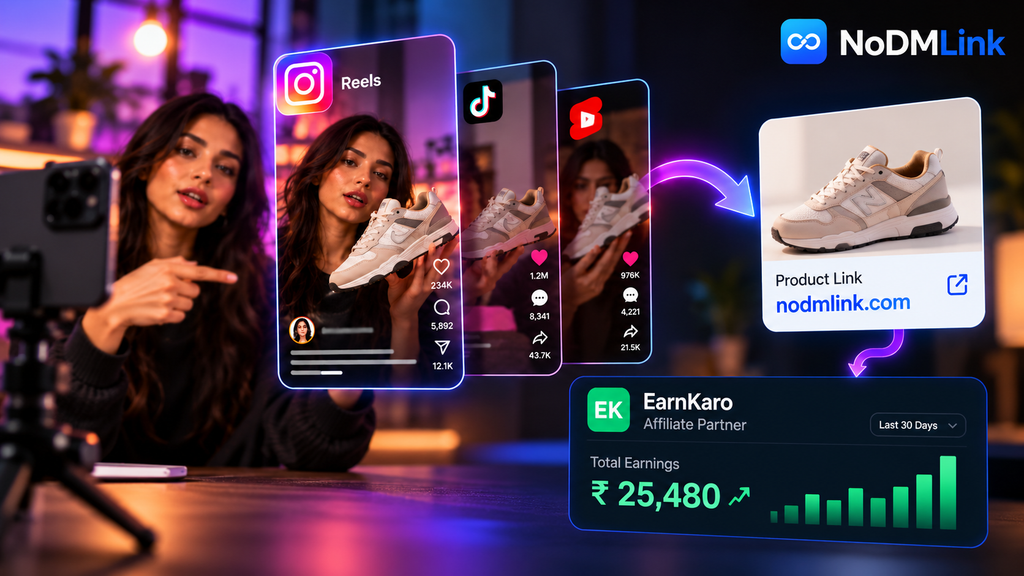
Creators on short-form video platforms inverted this model. They do not wait for the consumer to search; they push the product into the consumer’s feed. A 7-second video showing a viral cleaning product can generate 5 million views overnight. If just 1% of those viewers convert, the creator generates 50,000 clicks in a matter of hours. This burst traffic model allows creators to scale revenue exponentially without paying for server hosting or worrying about Google algorithm updates.
How Social Affiliate Networks Work
To monetize this traffic, creators rely on specific affiliate networks tailored for social media. Amazon Associates is the largest, but platforms like LTK (for fashion) and EarnKaro (for a wide variety of Indian and global retailers) provide specialized dashboards and payout structures.
The core technology relies on HTTP cookies and tracking parameters. When a creator generates an affiliate link, a unique alphanumeric identifier is appended to the URL (e.g., ?tag=creatorid-20). When a user clicks this link, the retailer’s server reads the parameter and drops a tracking cookie in the user’s browser. If the user completes a purchase within a specific timeframe—known as the attribution window—the server credits the sale to the creator’s account.
These attribution windows are critical. Amazon typically uses a 24-hour cookie. If a user clicks the creator’s link on Monday but waits until Tuesday to buy, the creator earns nothing. Other networks offer 7-day or 30-day cookies, providing a much higher safety net for delayed conversions.
The Link Routing Problem
The primary technical challenge in social affiliate marketing is routing the user. Instagram and TikTok do not allow clickable links in video captions. A creator cannot simply paste their ?tag= URL below the video.
Creators must force the user through an artificial routing funnel. Historically, this meant telling the user to navigate to their profile and click a Linktree URL, which then housed the specific affiliate link. As discussed in previous articles, this multi-step process destroys conversion rates due to high friction.
The modern solution is DM automation (commenting a keyword to receive the link directly) or using independent lookup directories. Tools like NoDMLink attempt to solve this routing problem entirely by allowing users to bypass the DM funnel and directly access the creator’s underlying affiliate URL from a centralized database.
The Invisible Traffic Phenomenon (Dark Social)
When millions of users are clicking links inside Instagram direct messages, standard web analytics break down. If you look at Google Analytics for an e-commerce store, traffic originating from a DM often registers as “Direct” rather than “Social Referral.” This is known as Dark Social.
The referring data (the HTTP Referer header) is stripped away when moving from a private mobile application chat window to a system browser (like Safari or Chrome). Retailers rely entirely on the affiliate tracking parameters embedded in the URL to understand where the sale came from. Without those specific ?tag= or ?aff_id= strings, the creator receives zero credit, and the brand has no idea which video drove the spike in sales.
This is why creators guard their direct links aggressively, using URL shorteners to mask the tracking codes and forcing users through specific engagement funnels to ensure the cookie fires correctly.
Frequently Asked Questions (FAQ)
How much commission do creators actually make?
Payouts vary wildly by category and network. Physical electronics on Amazon might yield a 1% to 3% commission, while digital software or beauty products on specialized networks can offer anywhere from 10% to 30%. A single viral video driving 10,000 clicks on a $50 product with a 5% commission yields $25,000 in gross sales and a $1,250 payout to the creator.
Do users pay a higher price when they use an affiliate link?
No. The retail price of the product remains exactly the same for the consumer. The affiliate commission is paid entirely out of the retailer’s profit margin as a marketing expense. The retailer is essentially paying the creator a finder’s fee for driving the traffic.
What happens if a user clears their browser cookies before buying?
If the user clears their cookies or switches from their phone’s in-app browser to a desktop computer without clicking the link again, the tracking chain is broken. The creator will not receive credit for the sale. This technical limitation is why creators urge users to “buy now” while the cookie is still active.