

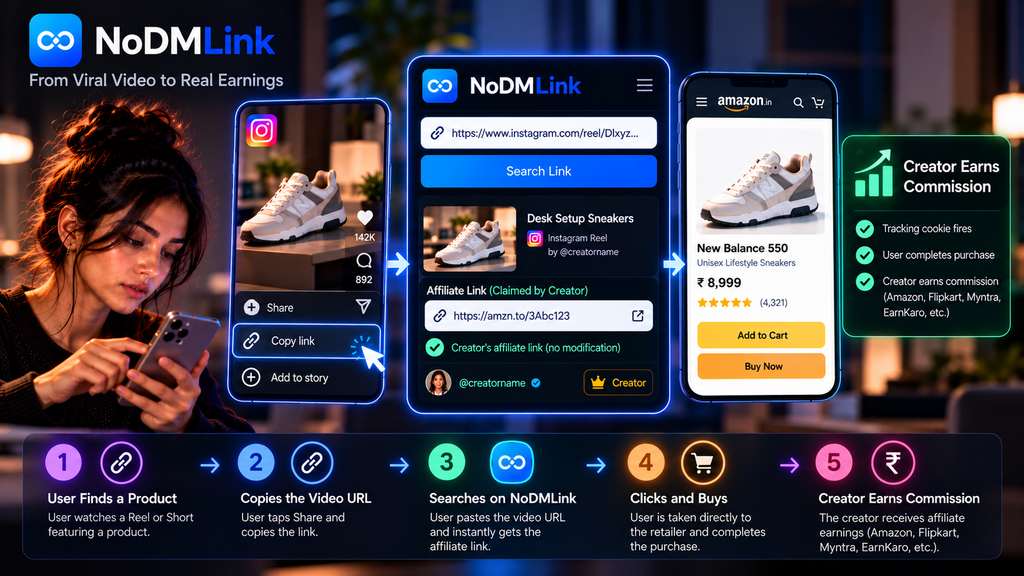
The modern buyer’s journey in social commerce is heavily fragmented. A consumer discovers a product while scrolling through Instagram Reels or TikTok, but the actual transaction must take place on an external retailer like Amazon or Shopify. Bridging this gap—moving the user from passive discovery to an active checkout—is the hardest technical challenge for creators. NoDMLink operates as the missing connective layer, repairing this fragmented journey and seamlessly turning product discovery into direct affiliate earnings.
Table of Contents
- The Broken Handoff in Social Commerce
- NoDMLink as the Connective Layer
- Maximizing Conversion Rates
- Prolonging the Shelf Life of Viral Content
- Frequently Asked Questions (FAQ)
The Broken Handoff in Social Commerce
Social media algorithms are fundamentally designed to retain attention, not export it. Platforms like Instagram and TikTok actively suppress content containing external links because every click away from the app represents lost advertising revenue. This structural conflict creates a broken handoff between the creator showcasing the product and the retailer selling it.
Creators are forced to utilize high-friction workarounds, such as demanding users navigate to a cluttered Linktree in their bio, or deploying third-party DM automation bots that require users to comment specific keywords. These workarounds create artificial bottlenecks, resulting in a massive drop-off rate of potential buyers.
NoDMLink as the Connective Layer
NoDMLink resolves this structural conflict by functioning as an independent, decentralized search engine specifically for social commerce. It acts as the bridge between the social media application (discovery) and the e-commerce storefront (checkout).
Instead of relying on the creator’s automated systems to push a link to the user’s inbox, NoDMLink empowers the user to pull the link on demand. By simply copying the video URL and pasting it into the NoDMLink directory, the user instantly retrieves the underlying affiliate link, bypassing platform restrictions and automated funnels entirely.
Maximizing Conversion Rates
In digital marketing, friction destroys conversion. Every additional step a user must take to reach a checkout page exponentially increases the likelihood of cart abandonment. Waiting two minutes for a DM bot to process an API request, clicking through a multi-link landing page, or struggling with Instagram’s clunky in-app browser all contribute to lost revenue.
By routing discovery through NoDMLink, the user flow is stripped down to its absolute minimum. Instant retrieval means the user accesses the affiliate link while their purchasing intent is at its absolute peak. Furthermore, opening the link via a standard web browser (rather than a social media app wrapper) ensures tracking cookies fire correctly, guaranteeing the creator receives their affiliate commission.
Prolonging the Shelf Life of Viral Content
The traditional social commerce model is highly ephemeral. A video might generate millions of views over a weekend, driving a massive spike in affiliate earnings, but once the algorithm stops promoting it, the revenue drops to zero instantly. The content dies.
NoDMLink fundamentally alters the economics of short-form video by giving it a permanent, searchable home. Because NoDMLink pages are indexed by traditional search engines, a creator’s viral video is transformed from a temporary spike into a persistent digital asset. Long-tail search traffic (e.g., users Googling “desk setup from that TikTok video”) can lead users to the NoDMLink directory months later, generating recurring, passive affiliate earnings long after the initial viral wave has passed.
Frequently Asked Questions (FAQ)
Is NoDMLink an e-commerce retailer?
No. NoDMLink does not process transactions, hold inventory, or manage shipping. It is strictly a routing directory. When a user clicks a link on NoDMLink, they are taken directly to the retailer (Amazon, Sephora, etc.) where the actual transaction occurs.
How does NoDMLink handle a video that features multiple products?
If a creator features an entire outfit or a room setup, the most effective strategy is for the creator (or contributor) to map the video URL to a specific collection page or a customized Linktree housing all the featured items, rather than a single product link.
Does this bypass ad-blockers?
Because the affiliate link is hosted in a standard web directory format, users utilizing strict ad-blockers or privacy browsers will still be able to access the raw destination URL, though certain tracking parameters may occasionally be stripped depending on the user’s local browser settings.