

The traditional funnel for online shopping is obsolete. Five years ago, a user identified a need, typed a query into Google, and clicked a link to an e-commerce site. Today, the product finds the user. Short-form video algorithms on Instagram, TikTok, and YouTube Shorts have transformed social media feeds into the world’s most aggressive and efficient product discovery engines. This shift from intent-based search to discovery-based commerce dictates how every creator monetizes their audience.
Table of Contents
- The Shift from Intent to Discovery
- The Death of Static Shopping Posts
- The Walled Garden Strategy
- The “Comment LINK” Bridge
- Frequently Asked Questions (FAQ)
The Shift from Intent to Discovery
Google relies on high-intent data. A user must know what they want to search for it. Social commerce relies on algorithmic prediction. The recommendation engine analyzes watch time, pause rates, and shares to predict what a user will buy before they actively seek it out.
If you watch a 15-second Reel of a desk setup and pause on a specific mechanical keyboard, the algorithm logs that interaction. Within an hour, your feed populates with five more videos featuring similar tech accessories. You did not search for a keyboard, but the platform generated the demand. This eliminates the search engine entirely, replacing it with a hyper-targeted, infinite scroll of product demonstrations.
The Death of Static Shopping Posts
Meta previously attempted to force social commerce through the “Instagram Shop” tab, which functioned like a traditional digital catalog of static images. It failed completely, and Instagram removed the dedicated tab from the home screen in 2023.
Static images cannot compete with short-form video. A Reel provides a dynamic, three-dimensional understanding of a product. You see how the fabric drapes, how the keyboard sounds, or how the software interface responds. This visual proof lowers the barrier to purchase significantly faster than a staged photograph. Creators acting as demonstrators build trust, which is why video conversion rates consistently outperform static image ads by massive margins.
The Walled Garden Strategy
Every major social network operates as a walled garden. Their primary directive is to keep Daily Active Users (DAU) inside the application for as long as possible. If a user clicks an external link to Amazon or an independent Shopify store, the social network stops generating ad revenue from that session.
To combat this, platforms attempt to force native checkouts (like TikTok Shop), where the user buys the product without ever leaving the app. The platform takes a percentage of the sale, and the user continues scrolling immediately after the transaction.
However, creators resist native checkout systems because external affiliate networks—like Amazon Associates, LTK, or EarnKaro—often provide better commission structures, longer cookie durations, and more control over the sales data.
The “Comment LINK” Bridge
This conflict between the platform (which wants to keep users in-app) and the creator (who wants to send users to external affiliate links) created the current state of social commerce. The “Comment LINK” automation trend is the compromise.
By forcing the user to comment and interact with a DM bot, the creator satisfies the platform’s demand for high in-app engagement. In exchange, the creator successfully routes the user to their external affiliate link via the direct message interface. It is a highly effective, albeit frustrating, workaround for users who just want to access the product page.
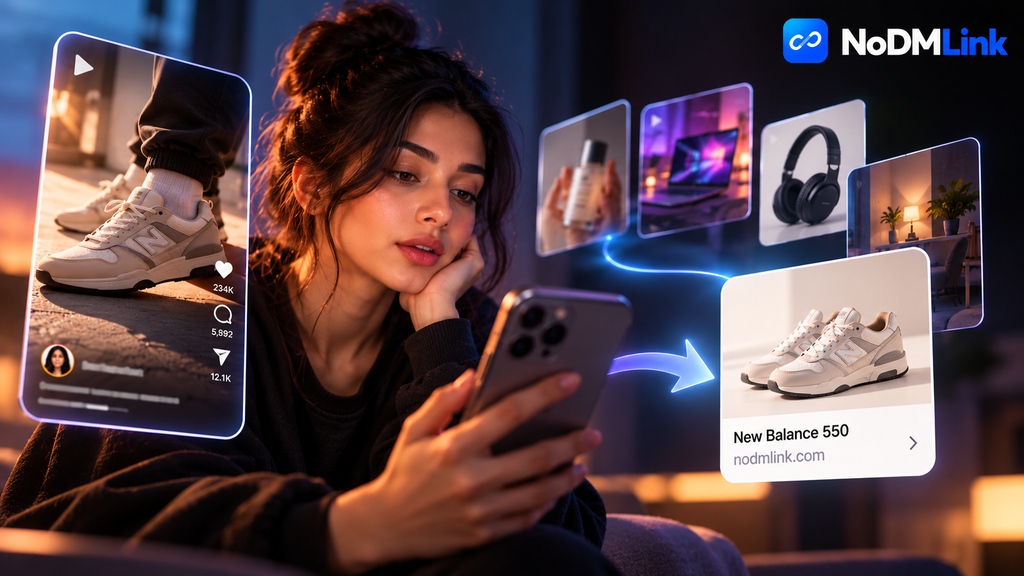
This friction is driving the adoption of third-party extraction tools. Instead of playing the engagement game, users leverage platforms like NoDMLink to paste the video URL and instantly retrieve the underlying product link, bypassing the walled garden’s artificial hurdles entirely.
Frequently Asked Questions (FAQ)
Why did Instagram remove the Shop tab?
User behavior data showed that people did not open Instagram with the explicit intent to browse a catalog. They open the app to consume content. Integrating product discovery directly into the content feed (Reels) proved to be a much more effective revenue driver than a separate shopping section.
Do creators earn more from native shopping or external affiliates?
It depends on the product category and the platform’s current incentives. However, external affiliate links usually offer a 24-hour to 30-day cookie window. If a user clicks the creator’s link but buys a different product three days later, the creator still gets the commission. Native checkout systems rarely offer this cross-product attribution.
How can users find the product if the creator doesn’t provide a direct link?
If a creator refuses to provide a link without a comment, users can search for the brand name in Google, use reverse image search on a screenshot of the video, or use dedicated link discovery databases like NoDMLink to find community-submitted destination URLs.