

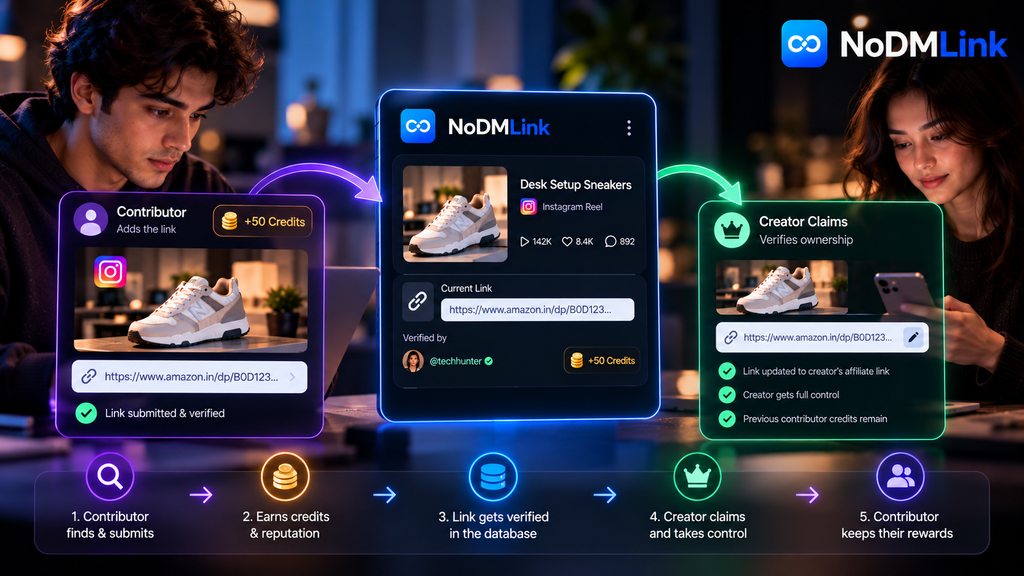
When a centralized database relies on crowdsourced data entry, questions of ownership and attribution inevitably arise. On NoDMLink, the most common intersection of users occurs when a community contributor indexes a viral video, and the original creator subsequently decides to claim it. To maintain a symbiotic ecosystem, NoDMLink has engineered a specific protocol that seamlessly transfers administrative control to the creator while permanently preserving the contributor’s earned rewards.
Table of Contents
- The Separation of Discovery and Administration
- Preserving Contributor Credit
- The Creator’s New Permissions
- Resolving Affiliate Conflicts
- Frequently Asked Questions (FAQ)
The Separation of Discovery and Administration
To understand the claiming process, you must understand how NoDMLink architecture separates database roles. The platform draws a hard technical line between the act of discovering a link and the act of administering a link.
When a contributor submits a new entry (mapping a TikTok URL to an Amazon product), they are performing the act of discovery. They are not granted ownership of the video. When the verified creator of that TikTok video claims the entry, they are assuming administration. The creator is given write-access to the database field containing the destination URL.
Preserving Contributor Credit
A major concern among the crowdsourced community is the fear of wasted effort. If a contributor spends time tracking down an obscure product link and getting it verified, do they lose their reward when the creator shows up?
No. NoDMLink permanently logs the metadata of the original discovery. The contributor’s username remains publicly associated with the initial indexing of the video. More importantly, the reputation points, trust score increases, and any financial credits the contributor earned upon the initial verification of the link remain permanently in their account. The creator’s claim does not retroactively penalize the contributor.
The Creator’s New Permissions
Once a creator successfully completes the verification process (currently handled via secure direct message with NoDMLink administration), their dashboard instantly updates to reflect their new permissions.
The creator gains total administrative control over the entry. They can instantly overwrite the community-submitted destination URL with their own parameter-rich affiliate link. If the product featured in the video goes out of stock, the creator can seamlessly redirect the NoDMLink entry to a backup product or a different retailer. If the creator wishes to opt out of the directory entirely, they have the authority to delete the entry.
Resolving Affiliate Conflicts
Because NoDMLink allows open submissions, a scenario occasionally arises where a contributor submits their own affiliate link to a creator’s video, attempting to siphon commission from the creator’s viral traffic.
The claiming system acts as the ultimate conflict resolution tool. The NoDMLink protocol defaults absolute authority to the verified content creator. When the creator claims the video, the contributor’s affiliate link is immediately overwritten. The platform ensures that the creator—the entity who actually produced the content and generated the traffic—retains total control over the monetization of that specific routing path.
Frequently Asked Questions (FAQ)
Is the contributor notified when a creator claims their submitted link?
Yes. The platform’s notification system sends an alert to the original contributor, informing them that the verified creator has assumed administrative control of the entry. The notification reiterates that their reputation points have been preserved.
Can a contributor dispute a creator’s claim?
No. The verification process requires the creator to prove ownership of the original social media handle (e.g., the specific Instagram or TikTok account that posted the video). Because this cryptographic proof of ownership is absolute, contributors cannot dispute the transfer of administrative rights.
What if the creator breaks the link after claiming it?
Once a creator claims a link, they assume responsibility for its functionality. If a creator updates the destination URL to a broken link or a 404 error, the community can flag the link as broken, which will alert the creator to fix the routing error via their dashboard.