

The modern creator economy is split between two distinct traffic routing architectures. Do you funnel your audience to a centralized Link-in-Bio directory, or do you force them into a direct 1-to-1 connection via automated DMs? Both methods aim to solve the same problem: moving a user from a social media video to a monetized external URL. This article breaks down the mathematical and psychological differences between the two routing methods, analyzes the conversion data, and determines which system yields a higher Return on Investment (ROI) for creators.
Table of Contents
- The Link-in-Bio Funnel (The Directory Approach)
- The Direct Link Funnel (The Automation Approach)
- Analyzing the Bounce Rate
- Conversion Rates: The Math
- The Third Option: Direct Lookup Directories
- Frequently Asked Questions (FAQ)
The Link-in-Bio Funnel (The Directory Approach)
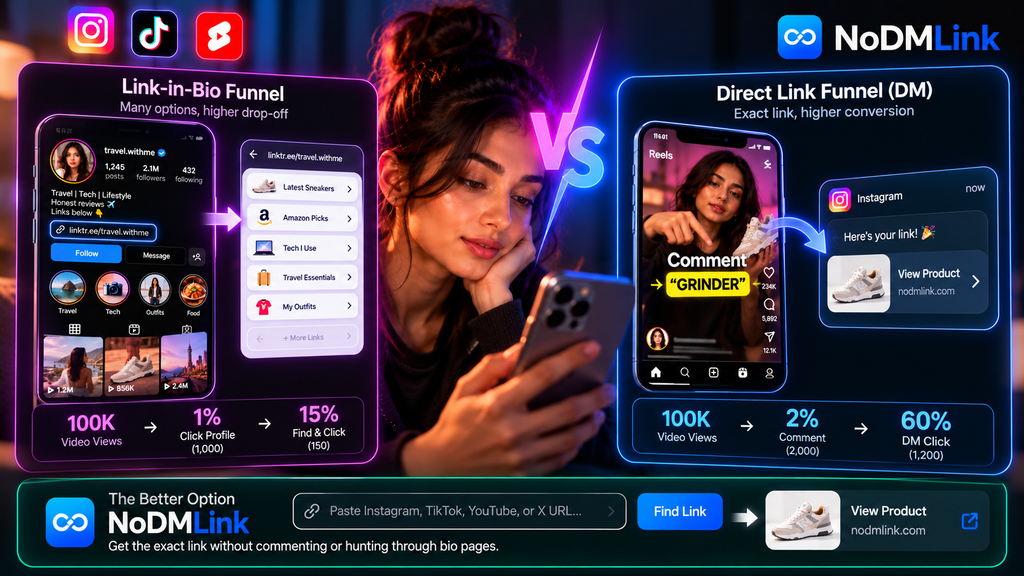
The Link-in-Bio model relies on a single, permanent URL placed in the creator’s profile (e.g., a Linktree or Beacons page). When a user clicks this link, they are presented with a mobile-optimized webpage containing a vertical stack of buttons, each pointing to a different destination.
The primary advantage of this model is its passive nature. A creator only sets it up once. It serves as a permanent digital storefront that houses their Amazon storefront, their latest YouTube video, their newsletter signup, and their primary brand sponsorships simultaneously.
The critical flaw in this architecture is cognitive load. If a user watches a Reel about a specific coffee grinder and is told to check the “Link in Bio”, they must navigate to the profile, click the bio link, and manually scan a list of 15 buttons to find the coffee grinder. This introduces severe friction.
The Direct Link Funnel (The Automation Approach)
The Direct Link model abandons the directory entirely. Instead of telling the user to hunt for a link, the creator instructs the user to comment a specific keyword (e.g., “GRINDER”) on the video. This triggers an API webhook via a third-party automation tool like ManyChat, instantly sending the exact destination URL to the user’s direct messages.
The primary advantage here is hyper-specific intent. The user gets exactly what they asked for without having to navigate a secondary menu. Furthermore, the act of commenting artificially inflates the video’s engagement metrics, tricking the Instagram algorithm into heavily promoting the content to a wider audience.
The flaw in this system is user fatigue. Many users do not want to fill their comment history with bot triggers, nor do they want automated marketing messages cluttering their private inbox.
Analyzing the Bounce Rate
In web analytics, a “bounce” occurs when a user lands on a page and leaves without interacting with it. When analyzing social traffic, the Link-in-Bio model suffers from massive bounce rates due to the Paradox of Choice.
When presented with too many options, the human brain often chooses to make no decision at all. A user arriving at a Linktree page with 20 identical-looking buttons will often become overwhelmed and close the browser window. Analytics confirm this: drop-off rates on multi-link directory pages routinely exceed 60%. Conversely, a direct link sent via DM bypasses the paradox of choice entirely. There is only one button to click, resulting in a significantly lower bounce rate.
Conversion Rates: The Math
To understand why top-tier creators have abandoned the Link-in-Bio strategy for specific product launches, we must look at the funnel math.
Scenario A: The Link-in-Bio Funnel
A video receives 100,000 views. Historically, about 1% of viewers will click the profile link (1,000 users). Of those 1,000 users who land on the bio page, perhaps 15% will successfully find and click the specific button for the product shown in the video. This yields 150 direct clicks to the affiliate link.
Scenario B: The Direct Link Funnel
The same video receives 100,000 views. Because the call-to-action is a simple comment, 2% of viewers interact (2,000 users). The automation bot sends 2,000 direct messages. Because the message contains the exact link requested with zero clutter, the Click-Through Rate (CTR) on the DM is often 60% or higher. This yields 1,200 direct clicks to the affiliate link.
The direct link automation model drives nearly 8x the volume of highly qualified traffic compared to a passive directory page.
The Third Option: Direct Lookup Directories
The friction of the DM model and the inefficiency of the bio model have created a demand for a hybrid solution. Users want the exact, specific link (like the DM model) without having to actively engage with a bot or hunt through a messy list.
Dedicated lookup tools like NoDMLink serve this exact purpose. By allowing a user to paste the URL of the social media video into a search bar, the tool instantly queries a database and returns the exact destination link associated with that specific video. It provides the hyper-specificity of a direct link while respecting the user’s desire to avoid engagement-bait tactics.
Frequently Asked Questions (FAQ)
Should creators use both methods simultaneously?
Yes. The most effective strategy is a hybrid approach. Creators use DM automation for specific, high-ticket product launches to maximize the algorithmic boost and direct conversions, while maintaining a Link-in-Bio page as a passive safety net for users who browse their profile days or weeks later.
Which method is better for high-ticket items?
Direct links perform exceptionally better for high-ticket items. High-priced products require high trust and low friction. Funneling a user through a generic Linktree degrades trust, whereas a direct, 1-on-1 message containing the exact product link maintains momentum and intent.
Do Instagram and TikTok throttle accounts that do not use a bio link?
No. The platforms do not penalize accounts for leaving the bio link field empty. In fact, keeping traffic strictly within the app (via comments and DMs) aligns better with the platform’s goal of maximizing active session duration.