

Crowdsourced databases are inherently vulnerable to vandalism, manipulation, and spam. Because NoDMLink relies on an open network of community contributors to map social media videos to their destination URLs, maintaining absolute database integrity is a core platform priority. To prevent bad actors from injecting malicious URLs or fake affiliate links, the platform utilizes a strict, multi-layered verification and reporting infrastructure designed to ensure trust and accuracy.
Table of Contents
- The Vulnerability of Crowdsourcing
- The Initial Submission Sandbox
- Community Verification and Consensus Voting
- The Reporting and Takedown System
- Frequently Asked Questions (FAQ)
The Vulnerability of Crowdsourcing
In an open directory, the incentives for manipulation are high. A bad actor might attempt to submit their own Amazon affiliate link to a creator’s viral video in order to steal commission. A more malicious user might attempt to route traffic to a phishing site disguised as a legitimate storefront.
If a user searches for a video on NoDMLink and is routed to a scam, trust in the platform evaporates instantly. Therefore, NoDMLink cannot assume that a submitted link is accurate; it must mathematically prove it before granting it widespread visibility.
The Initial Submission Sandbox
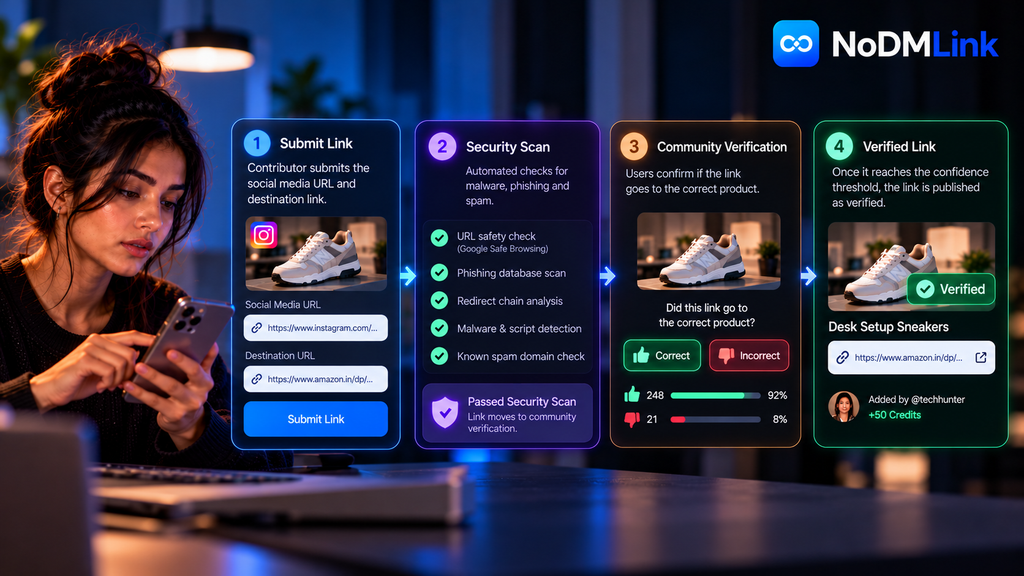
When a contributor submits a new destination URL for a video, it is not immediately pushed to the global public directory. Instead, the entry is placed into a pending state, often referred to as a “sandbox.”
During this phase, the NoDMLink backend performs automated security checks. The system queries the submitted URL against known phishing databases (such as Google Safe Browsing APIs) and traces the redirect chain to ensure the final endpoint does not trigger malicious script warnings. If a link fails these automated checks, it is immediately discarded, and the contributor’s account is flagged for review.
Community Verification and Consensus Voting
If a link passes the automated security scan, it becomes visible to users searching for that specific video, but it lacks the “Verified” status. NoDMLink relies on early adopters to validate the data.
When users click a pending link, the platform prompts them with a simple feedback mechanism: Did this link go to the correct product? Users can upvote (accurate) or downvote (inaccurate) the routing. This creates a real-time confidence score based on community consensus.
Once an entry crosses a specific algorithmic threshold of positive upvotes with a negligible bounce or downvote rate, the database locks the entry in as a “Verified Link.” The contributor who submitted it is then awarded their reputation points.
The Reporting and Takedown System
Even verified links are not immune to failure. A legitimate product page can go out of stock resulting in a 404 error, or a third-party affiliate network might retroactively alter a redirect to point to a dead page.
To combat link rot, NoDMLink features a robust user reporting system. Any user can flag a live link as “Broken,” “Inaccurate,” or “Malicious.” When a link receives multiple flags within a short timeframe, the system automatically degrades its trust score. This alerts community moderators and the verified creator (if the video has been claimed) to review the routing. If the link is indeed broken, it is temporarily de-listed until a contributor or the creator submits an updated URL.
Frequently Asked Questions (FAQ)
How long does it take for a link to become verified?
Verification speed is directly tied to the traffic volume of the source video. For a highly viral TikTok video driving hundreds of searches per minute, community consensus is reached, and the link is verified within minutes. For niche videos, it may take longer to accumulate the necessary upvotes.
What happens to a contributor who submits fake links?
The platform operates on a strict reputation economy. If a contributor intentionally submits inaccurate or malicious links, the community downvotes will quickly trigger an automated penalty. The user will lose their accumulated trust score, preventing their future submissions from ever leaving the sandbox. Severe infractions result in a permanent IP and account ban.
Does a claimed link need community verification?
No. When a verified creator claims a video and overwrites the URL, their submission bypasses the community consensus phase. Because the creator is the authentic owner of the content, their routing instructions are granted immediate administrative trust.